


finca noruega natural
finca noruega natural
Couldn't load pickup availability
FAR FROM ORDINARY…
farm: noruega
variety: red caturra
alt: 1380 masl
process: anaerobic natural
region: apaneca, el salvador
cup profile: jammy nectarine - toffee - plum
Harvest typically runs from January through March. Managers train the coffee pickers on how to cut the coffee cherry with the optimal degree of maturity for a suitable raw material. Before harvesting, areas of the farm are sampled through Brix measurements to best determine ideal ripeness. Picked coffee then heads to the mill where the following classifications are made ahead of processing:
From 0 to 20 degrees brix classification A = Processes: Full Washed or Semi-Washed
From 21 to 30 degrees brix AA or AAA classification = Processes: Honey, Natural, or Experimental
For Los Naranjos's Anaerobic Natural processed coffees, it is very important to have constant control of the pH to avoid overfermentation. The tanks and barrels are suitable for carrying out fermentation with greater control since they have degassers and drain valves. This allows us not only to measure the pH but also the development of sugars through a measurement of brix grains. Their Anaerobic Naturals are fermented in the tanks for 72 hours under constant monitoring until the pH levels reach 4.05 degrees. It is then moved to the drying area.
In this process, it is important to highlight that after the wet processing, the coffee is pre-dried for three days until it reaches approximately 60% humidity. Then it is taken to raised beds and avoid the risk of obtaining an uncontrolled or undesired fermentation. Their mill is located between two mountains, El Pilón and El Aguila, overlooking the coast of the Department of Sonsonate. The elevation is 1400 masl, which causes drying for the full-washed process to take longer than usual. However, this helps to have more homogeneous drying, a cleaner cup, and longer stability of the beans in storage.
Bed drying for Anaerobic Natural coffee has an average duration of 30-40 days. The coffees are stored once they have reached 10% humidity. Once they enter the warehouse, they are allowed to rest for 24 hours and the humidity is measured again to verify that it is maintained at 10%. This is to account for the climatic conditions of the mill. The dried cherry coffees are placed inside grain pro bags, in polypropylene bags, and sealed with a seam so they cannot be accidentally opened.
WE WOULD SUGGEST THIS COFFEE TO BE BREWED AS AN ESPRESSO
BREW GUIDE BELOW.
**IMPORTANT SHIPPING INFO**
PLEASE SELECT FROM TRACKED 24 or TRACKED 48 SHIPPING.
Brew Guide Below
Temperature
Temperature
For pour-over filter methods, aim for the mid 80’s. We are aiming to preserve the sweetness of these coffees. Espresso, aim for lower 90’s.
Ratios / dose / bloom
Ratios / dose / bloom
Pour over:
Larger doses, smaller water ratios.
Initiate a bloom with minimal water, leave for up to a minute then start your pulse pours to the desired amount.
Espresso:
For larger doses, aim for a slightly larger yield than a 1:2 ratio but again cater to your taste. Use a pre-infusion if possible. Aim for an extraction in the mid-20 seconds.
Rest periods
Rest periods
Please ensure a rest period of at least 3 weeks for ALL brew methods; each coffee will be different in terms of rest needed. All our coffees will benefit from a substantial rest period of anywhere from 3-6 weeks (!) Ideally, you will grind what coffee you need and not keep pre-ground coffee for any length of time. Espresso generally needs a longer rest period than filter coffees, to fully de-gas and settle.
Freezing
Freezing
Please don’t freeze our coffees, it’s largely to do with the nature of the rest periods needed to develop profiles. As soon as a coffee is frozen, the development stage stops.



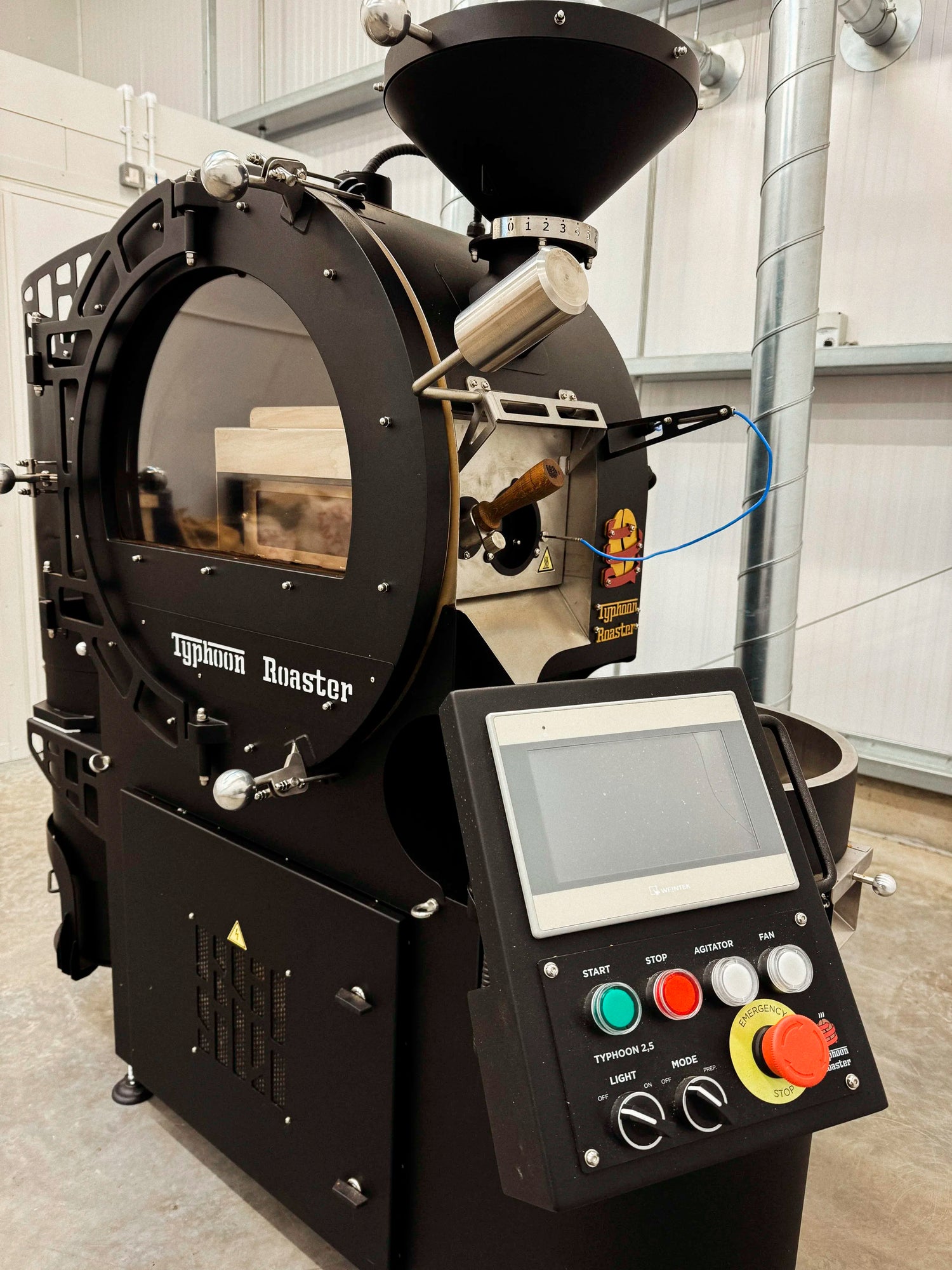
our process
we roast coffee in Livingston, near Edinburgh. Our roaster of choice is a typhoon fluid bed roaster. All electric.
all our coffees are rested before selling, to ensure they have developed fully before brewing. Optimal drinking is around the 3 week past roast date mark, although each coffee is uniquely different.
Coffee Info
Good to know
Roast Dates
We roast our coffees fresh every week so they can be enjoyed at their best – after a short rest. Following roasting, beans release CO₂ and their flavours gently settle, which is why we recommend letting them rest before brewing. For filter methods (V60, Chemex, Aeropress, batch brew), we suggest using the coffee from around 3–14 days after roast, with a sweet spot of 5–10 days. For espresso, we recommend 7–21 days, with lighter roasts often shining from 10–16 days. Store your coffee in a cool, dark place in a sealed bag or airtight container, and you’ll taste the clarity, sweetness, and balance that proper resting brings.
How our coffee gets to you
Otherwise known as Shipping and Despatch - we use Royal Mail if shipping in the UK and UPS if shipping abroad. We aim to ship off ASAP after purchase. This is different pre pre-orders or some limited runs, so be sure to either check the product page, or ask!
Unsure about something?
If you want clarity on anything or some help with brewing methods, just get in touch. No such thing as a stupid question...
Best place to reach us is on Instagram, through the website or andrew@thesourcecoffee.co.uk